Japan


Efficient use of resources including circularity
- Basic Concept
- Efforts in product use
- Efforts for End-of-Life Vehicles
- Efforts in production
- Efforts in the Supply Chain, etc.
Basic Concept
The demand for natural and water resources continues to rise due to worldwide population growth and economic development. Consequently, issues such as resource depletion, increasing waste, and tightening water resources are becoming increasingly apparent. Furthermore, the transition to a decarbonized society and rising geopolitical risks have made the stable procurement of resources a global issue. To pass on these limited resources to future generations, it is essential to reduce resource consumption while promoting recycled use.
Suzuki promotes resource-saving, reuse, and proper disposal throughout the entire product lifecycle from raw materials to end-of-life. Based on the concept of extended producer responsibility, Suzuki participates in the dismantling and resource recovery of end-of-life vehicles in India and is working to establish a resource recycling system in that country. Suzuki also views water as a critical input resource, assesses water risks at its various sites and among its business partners, and strives for efficient use, such as reducing water intake volumes. Guided by the Philosophy of Conduct, “Sho-Sho-Kei-Tan-Bi (Smaller, Fewer, Lighter, Shorter, Beauty),” Suzuki uses resources effectively and contributes to the realization of a sustainable society.
Efforts in product use
Design and development efforts
Efforts in automobiles
Continuation of designs aimed at reducing materials
Among the 3Rs, the first priority should be Reduce (waste reduction). Guided by the Philosophy of Conduct, “Sho-Sho-Kei-Tan-Bi (Smaller, Fewer, Lighter, Shorter, Beauty),” Suzuki is promoting waste generation reduction by thoroughly reducing materials used and reducing weight.
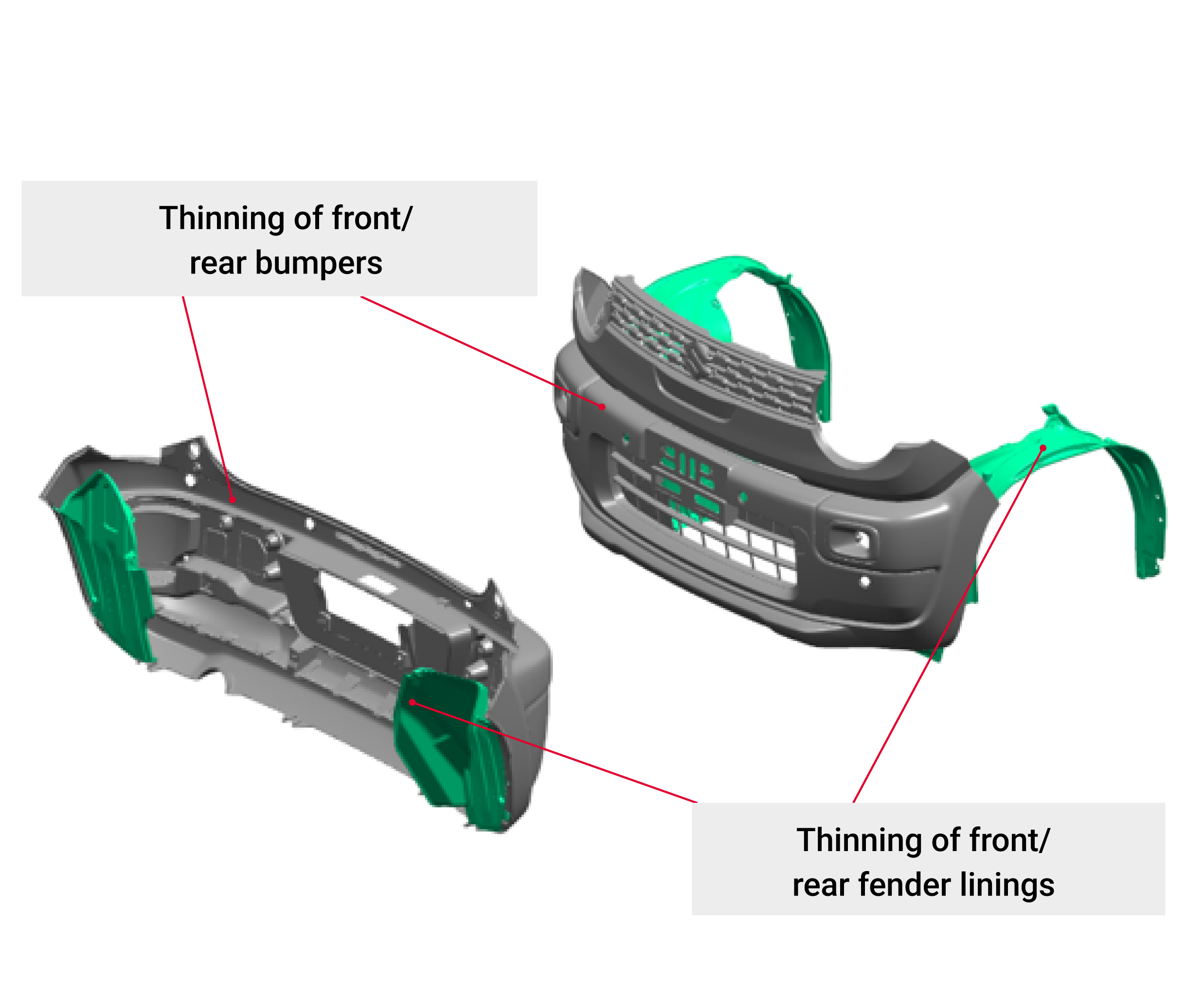
For example, for exterior parts, we made front and rear bumpers and fender linings thinner.
Adopting plant-derived resin (bio polycarbonate)
Suzuki is adopting bio polycarbonate resin (bio PC), which is primarily made of plant-based isosorbide, for automobile parts. In doing so, we are contributing to efficient use through the adoption of petroleum-free raw materials. Bio PC produces great color, and by coloring the resin material, it creates an appearance equivalent to that of painted resin, thereby enabling us to reduce CO2 and VOCs by eliminating the painting process.
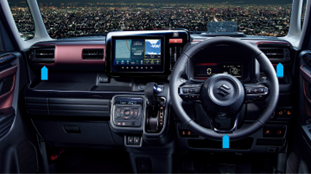
We first adopted Bio PC for the interior color panels of the first-generation Hustler in 2014, and since then, have adopted it for interior parts of the Lapin, Spacia, WagonR, Jimny, Swift, XBEE, the second-generation Hustler, and Spacia. Since we adopted Bio PC for the first-generation Hustler, we have developed a second-generation material with improved impact resistance and a third-generation material that is both more impact resistant and better looking, and have adopted it in an increasing number of models. We adopted Bio PC for exterior parts such as the front grille of the S-CROSS sold in Europe in 2021, and for exterior parts such as the front grille of the Solio and VITARA in FY2024. The Hustler, released in May 2026, adopted a plating-free emblem made by integrally molding two colors of Bio PC. In FY2025, the total annual amount used was roughly 1,115 tons for all models combined.
Suzuki will continue to expand the adoption of Bio PC by using these materials and technologies for mold and molding pre-colored resin materials.

Swift, Spacia Custom, and Fronx bumper grilles have been certified with the Biomass Mark

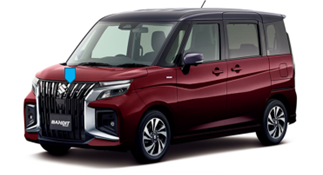
Suzuki's Swift, Spacia Custom, and Fronx bumper grilles have been certified with the Biomass Mark*1. Suzuki was also awarded the 14th Biomass Product Promotion Achievement Award by the Japan Biomass Products Promotion Council for its outstanding efforts in promoting biomass products.
The resin material used for the bumper grilles is biomass polycarbonate (DURABIO*2), an environmentally friendly material that contains 53% isosorbide, a plant-derived industrial starch. Furthermore, the high-brightness coloring material eliminates the need for painting, contributing to reducing the CO2 and VOCs that cause air pollution during manufacturing.
Suzuki has expanded the use of biomass materials in automotive components to include the Hustler (interior color panels) launched in 2014. When compared to the use of petroleum-derived materials, CO2 emissions have been reduced by 975t-CO2eq/year and VOC emissions by 50t/year (November 2023 to October 2024)*3. Additionally, we are actively using plant-derived materials in areas other than automotive components, such as the release of a Jimny-designed mug made from cellulose as an original accessory in June 2024.
- *1 Biomass Mark: The biomass mark is a symbol used to denote environmentally friendly products that utilize biological resources (biomass).
- *2 DURABIO™: A bio-engineered plastic developed by Mitsubishi Chemical Corporation, whose main raw material is plant-derived isosorbide. DURABIO is a plant-derived transparent engineering plastic that has various properties that differ from general petroleum-derived polycarbonate resin, and has particularly high functionality in terms of weather resistance and surface properties.
- *3 The reduction amount is only for the Swift and Spacia Custom.
Efforts in recycling
Adoption of recyclable resin materials
Automobile manufacturing that takes recycling into account (recyclable design) is an important initiative in vehicle design.
Suzuki works hard every day to create eco-friendly vehicles, such as by employing easy-to-recycle materials for exterior and interior resin parts.
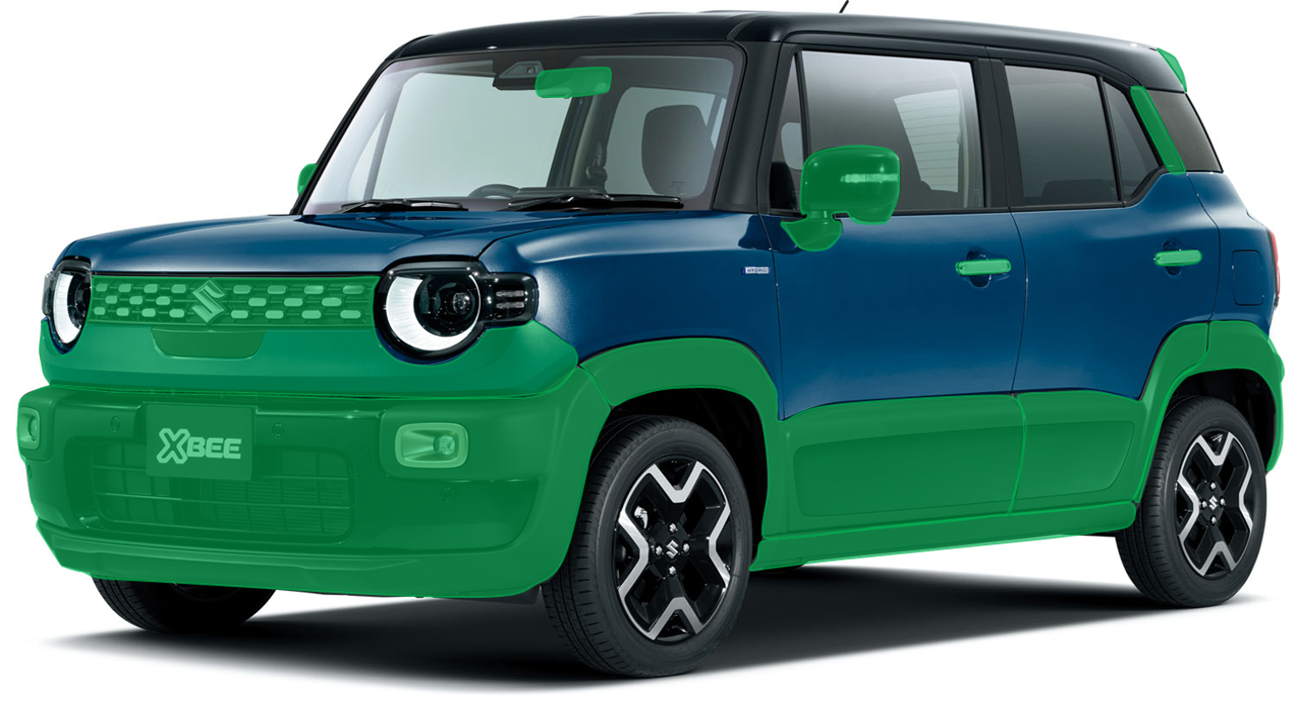
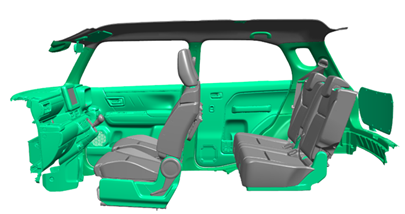
Promoting effective use of resources through expanded use of recycled materials
Suzuki is promoting the active adoption of recycled materials in collaboration with business partners, with the aim of realizing a sustainable society.
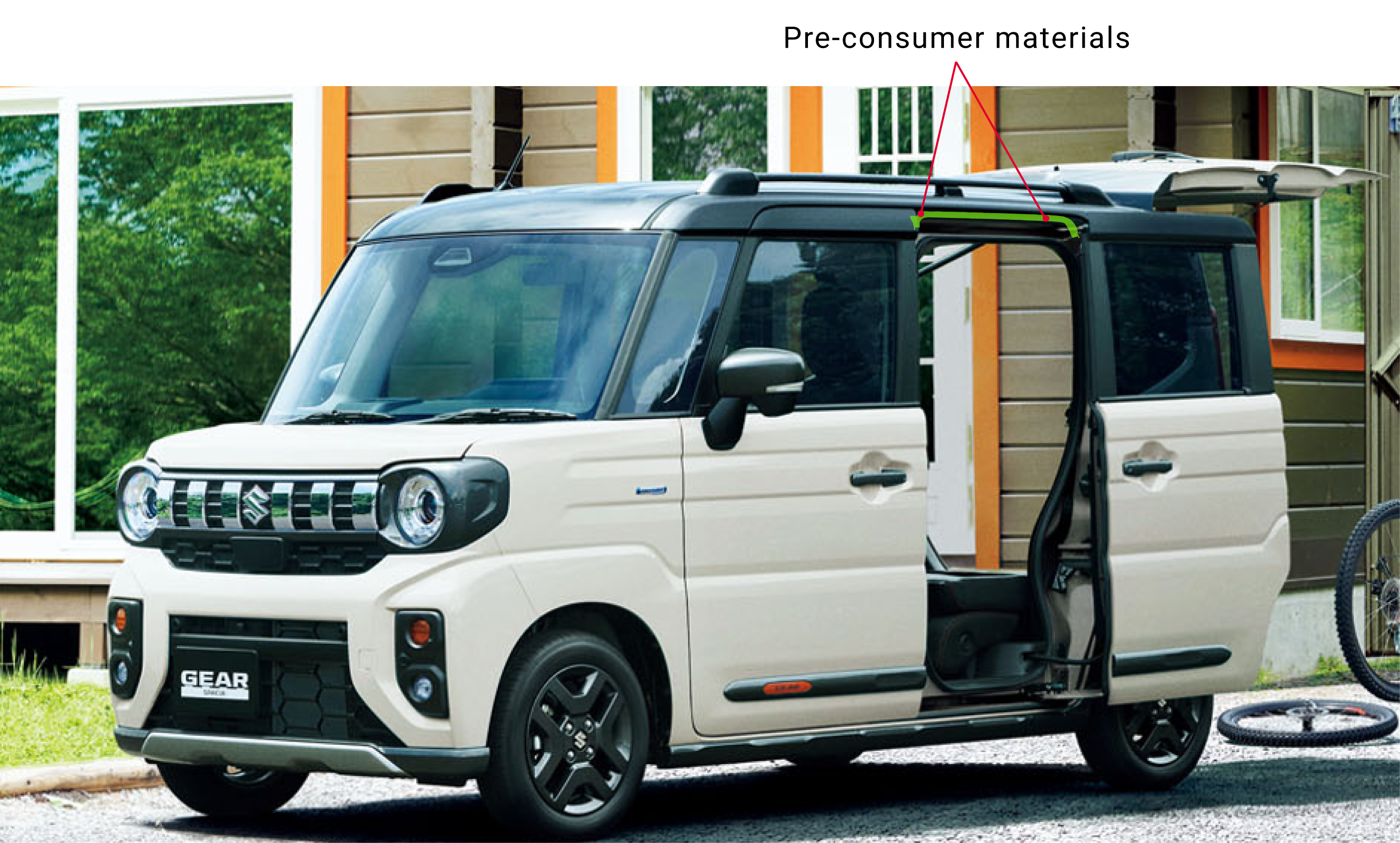
Even for rubber materials that have historically been considered difficult to recycle, we reuse pre-consumer materials (*) to reduce the amount of materials used, thereby reducing the environmental impact throughout the entire product lifecycle.
* They are recycled materials that effectively utilize materials not used in the original products during the manufacturing process as resources, excluding reprocessed products and scrap that are reintroduced within the same process.
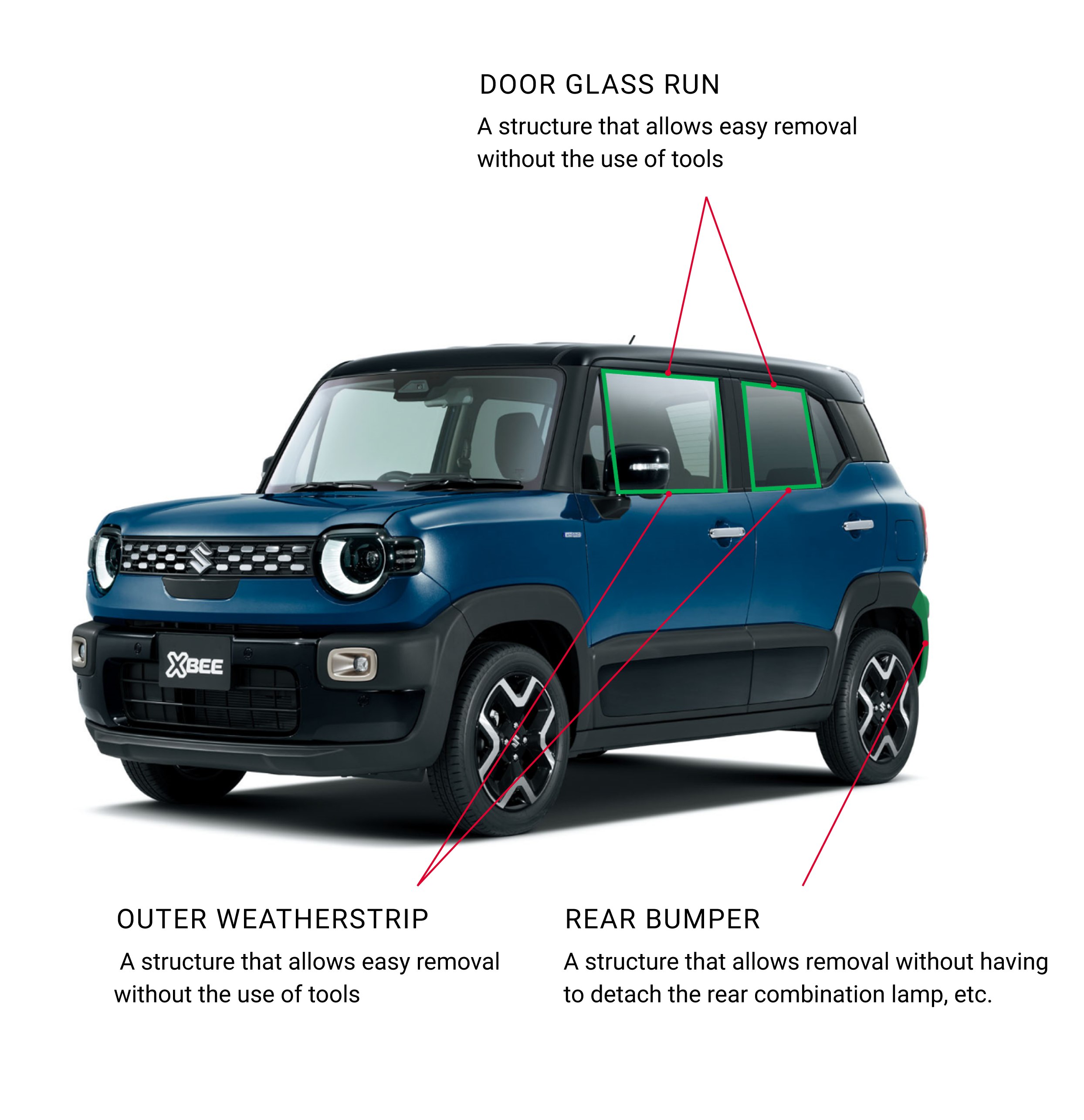
Design that considers recycling
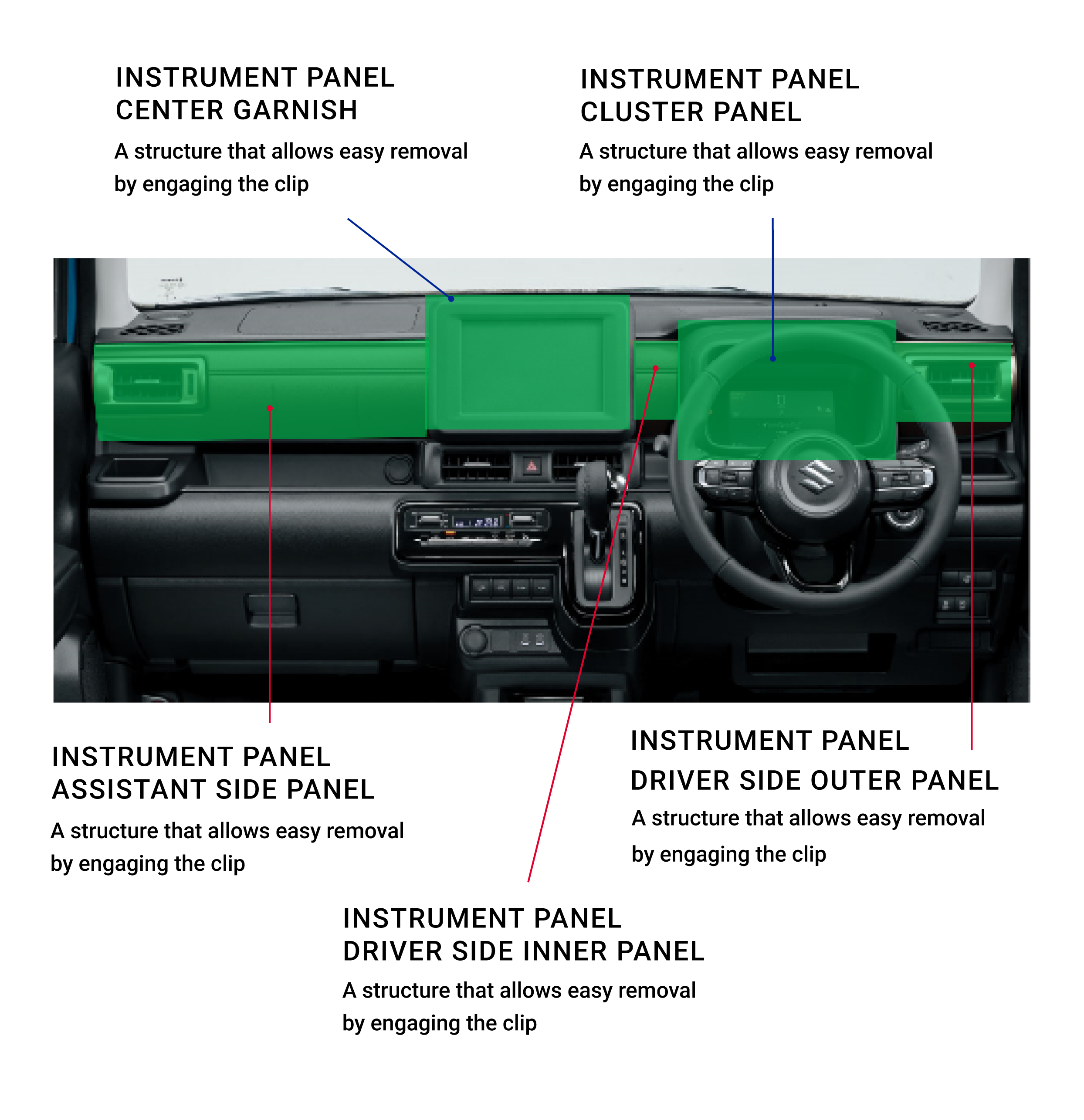
We consider recyclability from the earliest stages of vehicle design and development, and we are working to create vehicles that are simple to dismantle and disassemble.
Eco-friendly seat
Adoption of seat fabric that reduces dye wastewater and water use
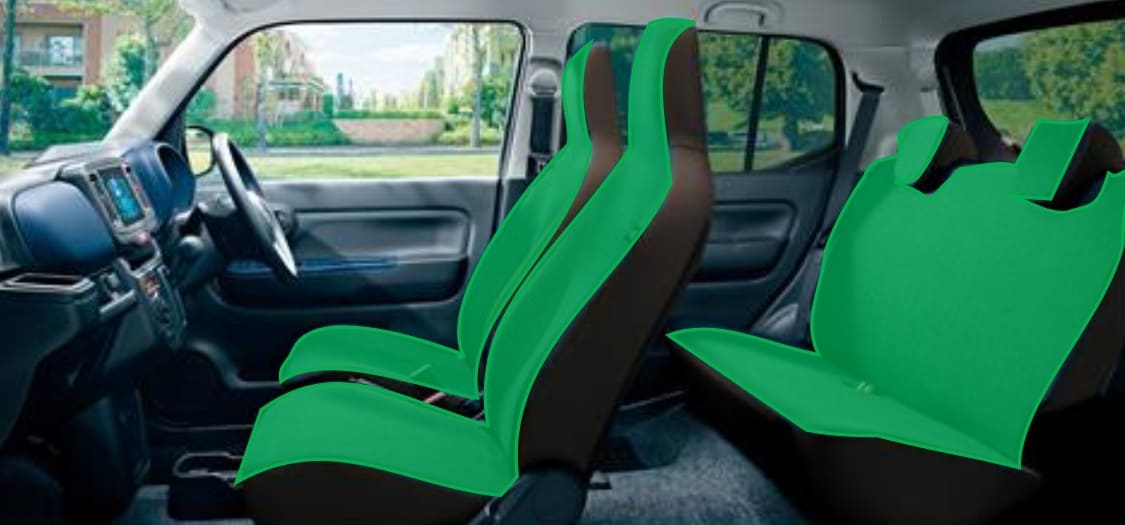
The Alto, launched in December 2021, features seats using solution-dyed yarn*1 on the surface.
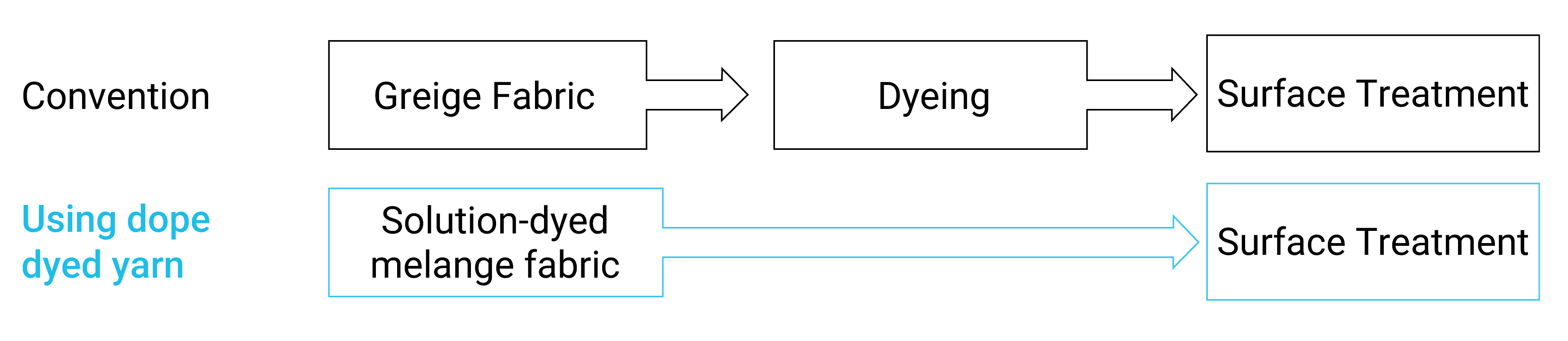
Using solution-dyed yarn makes it possible to reduce dye consumption by 42% and water use by 19% compared to conventional dyeing processes.*2
We are making effective use of limited resources and creating products that are environmentally friendly.
- *1 Solution-dyed yarn: Yarn made by adding pigments to color it during the process of melting raw materials and turning them into fibers.
- *2 According to research by Suminoe Teijin Techno Co., Ltd.
Process concepts
HYBRID
Efforts in motorcycles
Development and design that considers weight reduction
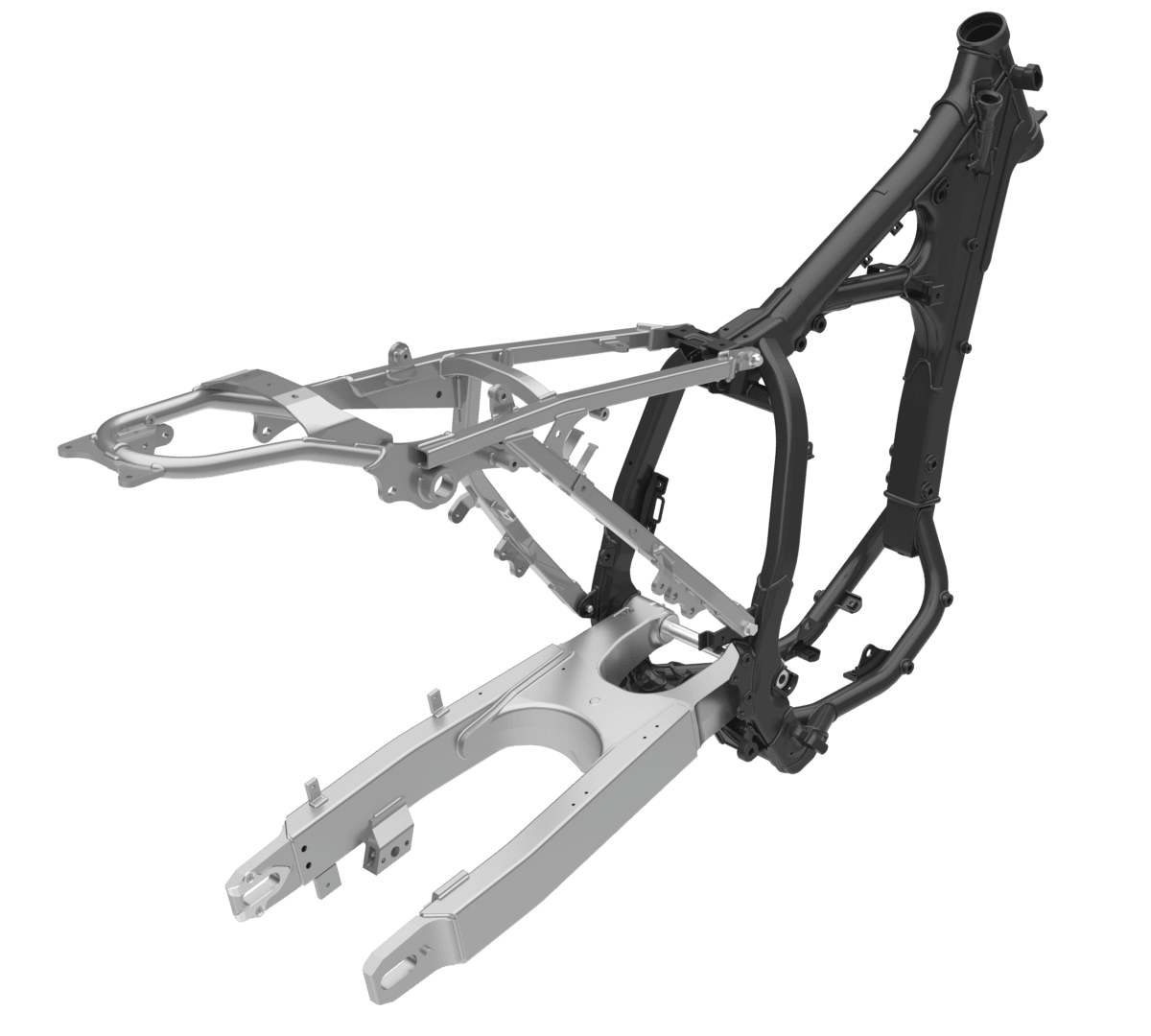
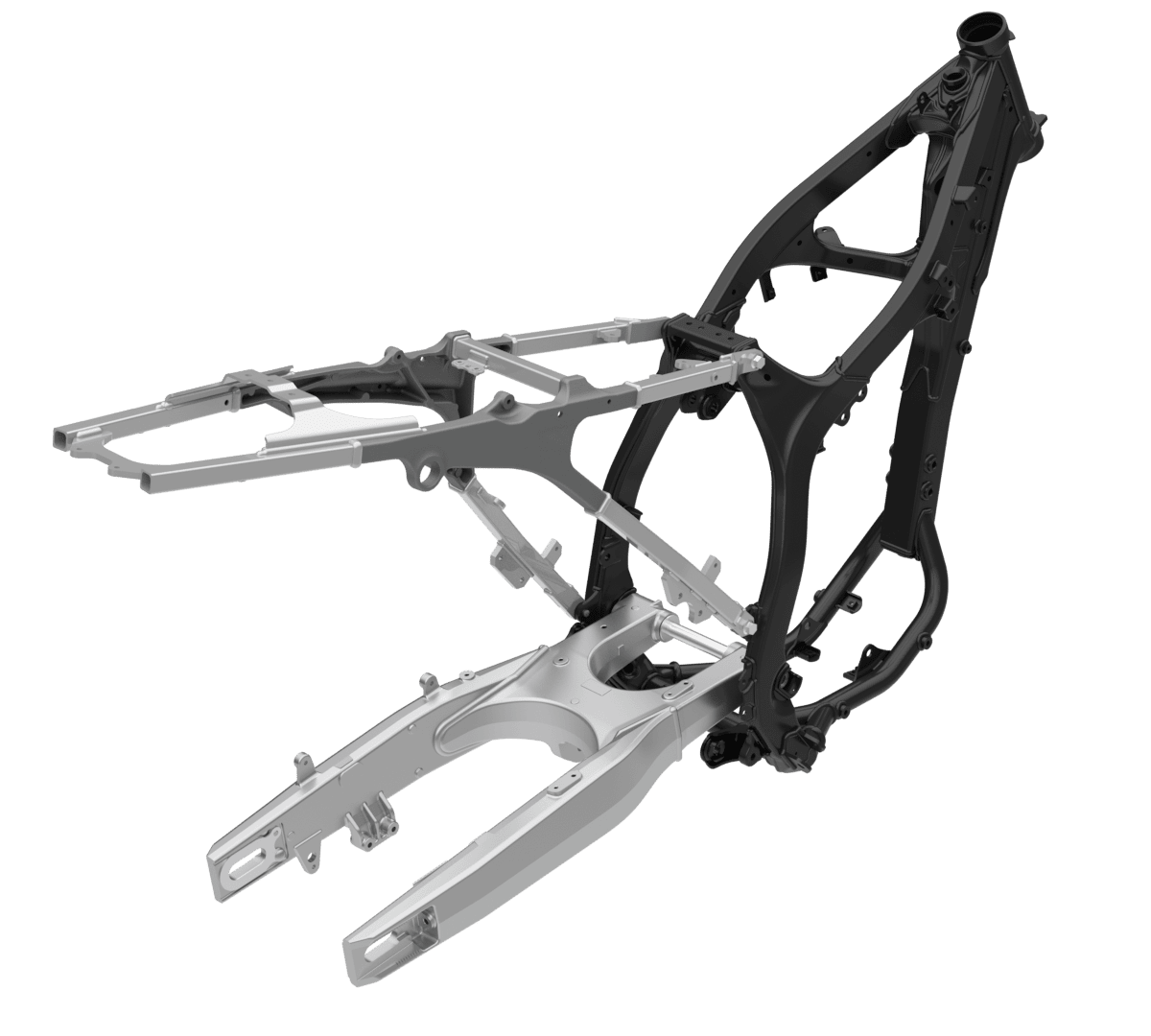
We have made significant changes to the shape of the new DR-Z4S's frame compared to that of the current DR-Z400S in order to comply with regulations, but in pursuit of a design that delivers "Smaller, Fewer, Lighter, Shorter, Beauty" the weight increase has been kept to just 5% by simplifying the structure and optimizing plate thicknesses.
Adoption of recyclable resin materials
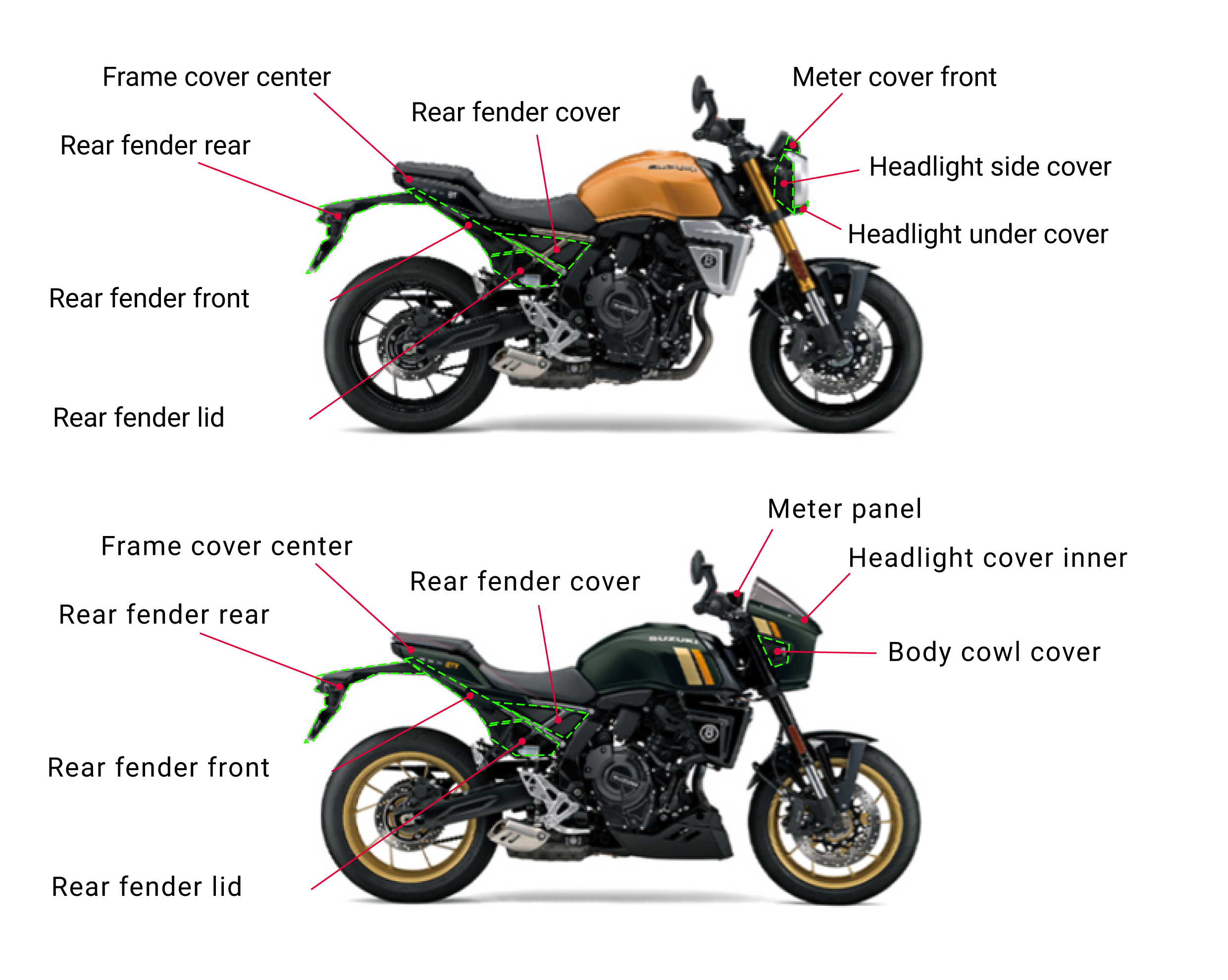
Suzuki is making efforts to incorporate recycling in the design and development of motorcycles. We use easily recyclable PP resin materials in the exterior parts of the new GSX-8T/8TT shown below.
Efforts for End-of-Life Vehicles
Efforts in end-of-life vehicle collection and recycling
Efforts in reuse
Rebuilt parts (reused parts) for repair*
In order to use natural resources effectively and reduce the financial burden on customers, Suzuki uses rebuilt parts for automatic transmissions, including CVT.
* Rebuilt parts are parts that are removed and collected at the time of repair; the parts are refurbished by replacing any damaged or worn parts, and then undergo final inspections.
Development of reuse technology for used lithium-ion batteries
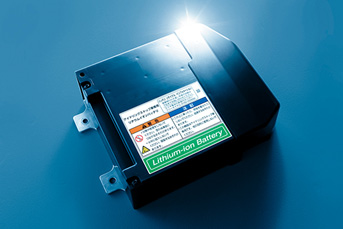
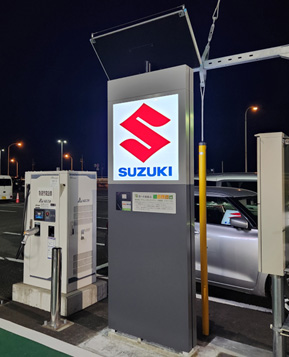
We have been promoting the reuse of lithium-ion batteries( the photo on the upper left) installed in our Mild Hybrid vehicles starting with the launch of the Wagon R in September 2012. As a result, we have developed technology to reuse lithium-ion batteries collected from end-of-life vehicles as power sources for solar street lights.
Conventionally, the used lithium-ion batteries that still have remaining capacity have been disposed of. However, this technological development makes it possible to reuse the batteries from ten end-of-life vehicles to power a single solar street light.
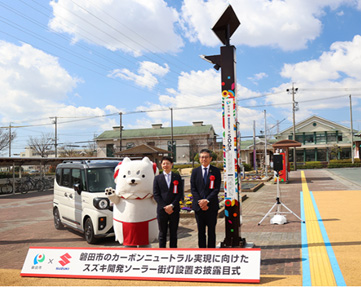
Currently, these street lights are installed at six Suzuki Group locations—the Head Office, Kosai Plant, Marine Technical Center, Yokohama Laboratory, Suzuki Plaza, and Osuka Plant—as well as at Amuse Toyoda in Iwata City, Shizuoka Prefecture (photo at lower left).
Suzuki also applied this street-light technology to install signage powered by reused lithium-ion batteries recovered from 12 end-of-life vehicles at Suzuki Arena Shinohara Plaza, operated by Suzuki Motor Sales Hamamatsu (photo on the right).
Suzuki will continue to promote the reuse of used lithium-ion batteries toward the realization of a circular economy.
Efforts in recycling
Efforts to comply with recycling laws in Japan
Efforts to comply with the Automobile Recycling Law
In accordance with the Automobile Recycling Law*1 enacted in January 2005, we collect and recycle shredder scraps (ASR*2), airbags, and CFCs from end-of-life vehicles.
Implemented in FY2025 (from April 2025 to March 2026) is as follows.
- *1 Automobile Recycling Law: Formal name “Act on Recycling of End-of-Life Vehicles”
- *2 ASR: Automobile Shredder Residue
Collection and recycling of ASR
Our ASR recycling rate was 96.0% in FY2025, and since FY2008, we have continuously achieved the legal standard enacted in FY2015 (70% or higher). We have achieved a vehicle recycling rate of 99.3%*3.
We are promoting the collection and recycling of ASR through ART*4 formed by 12 automobile manufacturers, etc. (as of March 31, 2026), including Nissan Motor Co., Ltd., Mazda Motor Corporation, and Mitsubishi Motors Corporation, working together with recycling companies nationwide for the purposes of complying with regulatory requirements, properly disposing of waste, increasing recycling rates, and reducing disposal costs.
Trends in the ASR recycling and vehicle recycling rates*5
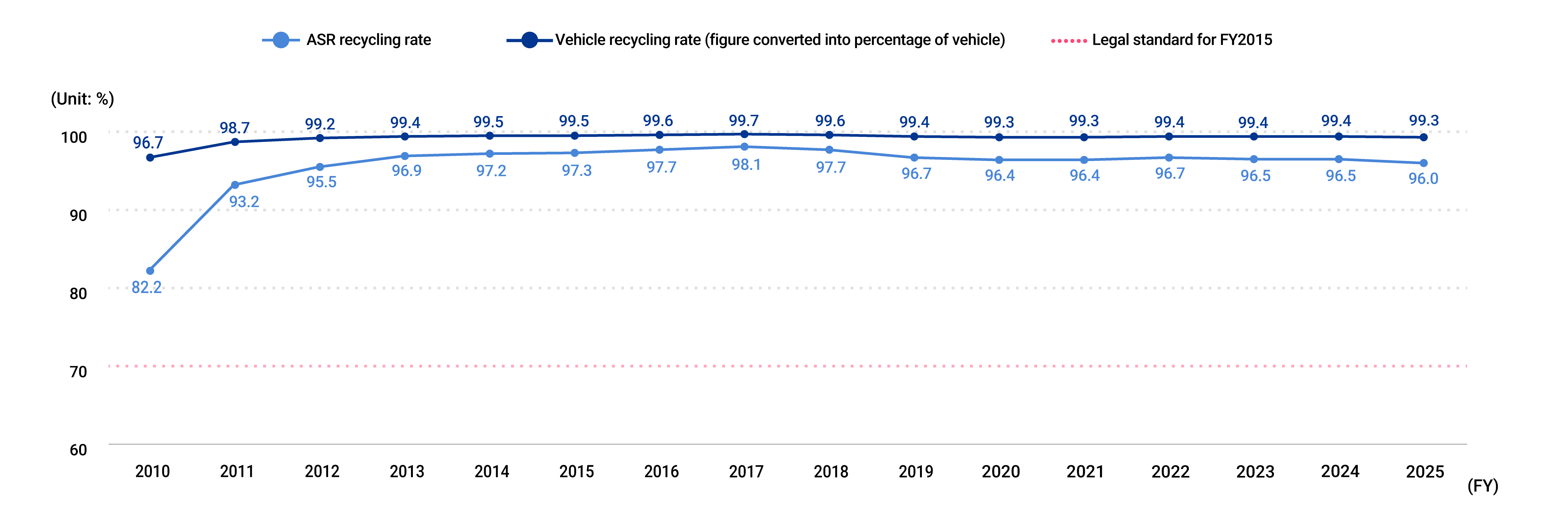
- *3 Calculated as the percentage recycled up to the dismantling and shredding processes (approximately 83%, quoted from the May 2003 joint council report), plus the remaining ASR ratio of 17% multiplied by the ASR recycling rate of 96.0%
- *4 For more information on the initiatives and recycling accomplishments of the automobile shredder residue recycling promotion team, please visit the website below.
The linked page is available in Japanese only.
https://www.suzuki.co.jp/about/csr/recycle/index.html - *5 The recycling rate figures for FY2023 and prior have been revised retroactively due to a revision of the calculation method
Collection and recycling of airbags and fluorocarbons
Our airbag recycling rate was 97.3%, and since FY2004, we have continuously achieved or fulfilled the legal standard (85% or higher). We collected and disposed of 62.6 tons of CFCs. For the collection and recycling of airbags and collection and disposal of CFCs, Suzuki and all manufacturers organized the Japan Auto Recycling Partnership for working together with recycling companies throughout the nation. In order to make continuous efforts to further promote end-of-life vehicle recycling, we will design easy-to-recycle products, conserve and effectively use resources, reduce waste, reduce the cost of recycling, and establish a stable recycling system.
Overseas recycling efforts
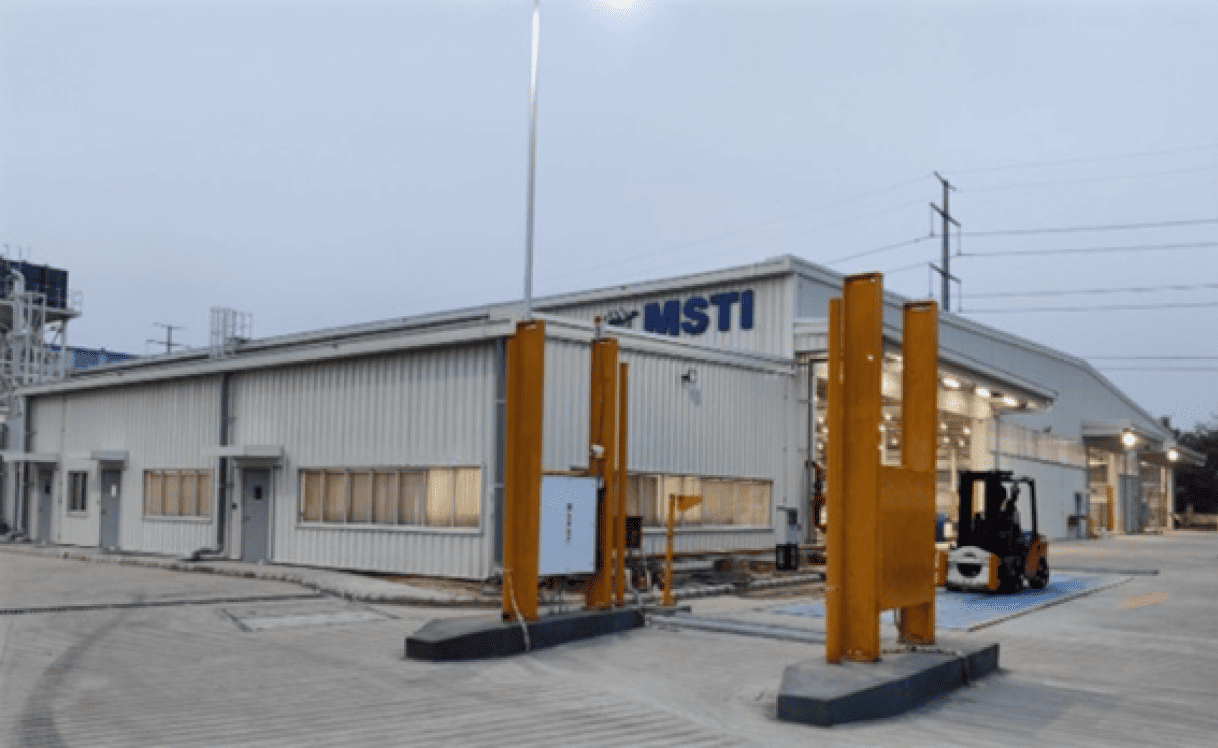
In India, Maruti Suzuki India established a joint venture, MSTI (Maruti Suzuki Toyotsu India Private Limited), with the Toyota Tsusho Group ahead of legislation to properly dismantle and recycle end-of-life vehicles. It began operating a model facility in October 2021, and by the end of FY2025, it had properly disposed of a cumulative total of at least 20,000 end-of-life vehicles, primarily automobiles. In addition, the second plant began operations in July 2026, and we are working to strengthen the proper disposal system.
Through this initiative, we aim to reduce the illegal dumping of vehicles and parts, and also tackle environmental issues such as resource recycling, global warming, soil and water contamination.
In the European Union, according to the End-of-Life Vehicles Directive (ELV Directive: 2000/53/EC) and the EU Battery Regulation (EU2023/1542) that took effect in August 2023, we are promoting measures such as the collection and recycling of ELVs and batteries, etc., in accordance with the laws, regulations, and conditions of each country.
We also provide information on the dismantling of new automobiles to disposal companies in a timely manner through the International Dismantling Information System (IDIS), which is jointly organized by automobile manufacturers. Moreover, the EU’s Reusability, Recyclability, and Recoverability Directive (RRR Directive: 2005/64/EC) requires that new vehicles be recyclable to a minimum of 95% as a condition for receiving the type approval of motor vehicles. To satisfy the requirements of the directive, we were audited by an authorized auditing agency on our systems and structures for collecting material data and verifying substances of concern. As a result, we acquired a Certificate of Compliance (COCom) in August 2008 and RRR Directive approval for all of our vehicles sold in Europe. Subsequently, we underwent an audit by an authorized authority based on the revised European RRR Directive (2009/1/EC), and obtained a new Certificate of Compliance (New COCom) in October 2011. This has been renewed every two years since then, and new vehicle models have been approved under the revised European RRR Directive.
Voluntary recycling efforts
Efforts for recycling of bumpers
To reduce resource consumption and realize a circular economy, we have been collecting and recycling used bumpers that have been removed from automobiles by distributors after repair and replacement.In FY2025, approximately 74,000 used bumpers were collected.
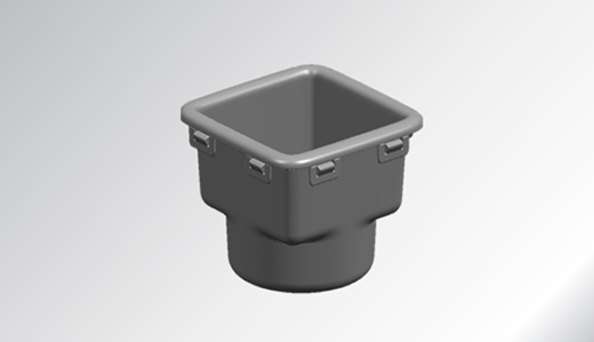
To improve transportation efficiency, we have installed bumper shredding machines at distributors nationwide (with some exceptions). As a result, the volume of the bumpers at the time of transportation was reduced to approximately one-sixth of the previous volume, allowing for a reduction of CO₂ emissions associated with collection and transportation. Collected bumpers are recycled and reused to produce automotive parts such as luggage boxes and cup holders.
Examples of parts using recycled materials derived from replaced bumpers
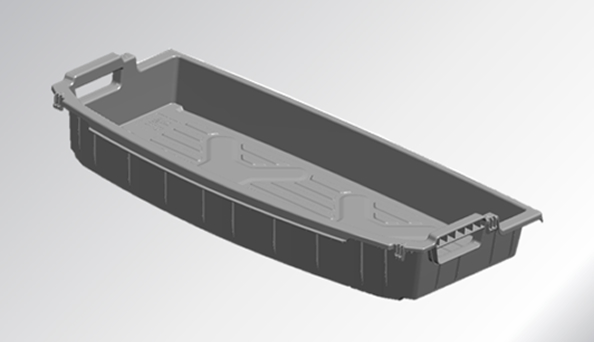
Luggage floor box
Floor console cup holder
Recycling of batteries
Collection and recycling of used lithium-ion batteries in Japan
Lithium-ion batteries are employed by models using the low fuel consumption technologies ENE-CHARGE, S-ENE CHARGE, Mild Hybrid, and Hybrid.
In conjunction with the start of a free collection system for lithium-ion batteries with the Japan Auto Recycling Partnership as the point of contact, Suzuki joined the collection system and has been collecting and properly disposing of used lithium-ion batteries. The cumulative number of used lithium-ion batteries collected through FY2025 has reached 60,000 batteries.
For more details on collection and recycling of used lithium-ion batteries, access the following website.
https://www.suzuki.co.jp/about/csr/recycle/traders/#area2
* The linked page is available in Japanese only.
Collection and recycling of used lithium-ion batteries overseas
Suzuki has launched models equipped with the SHVS Mild Hybrid system that uses lithium-ion batteries, and those equipped with a hybrid system, and in 2026, it began sales of the new battery electric vehicle (BEV), the “e VITARA.” Suzuki has built a system for collecting and recycling used lithium-ion batteries in accordance with laws and regulations, and local conditions of each country, including the EU Battery Regulation (EU2023/1542).
In India as well, Suzuki has launched models equipped with lithium-ion batteries, including the “e VITARA,” and Maruti Suzuki India has established a system for collecting and recycling used lithium-ion batteries.
Regarding voluntary motorcycle recycling efforts
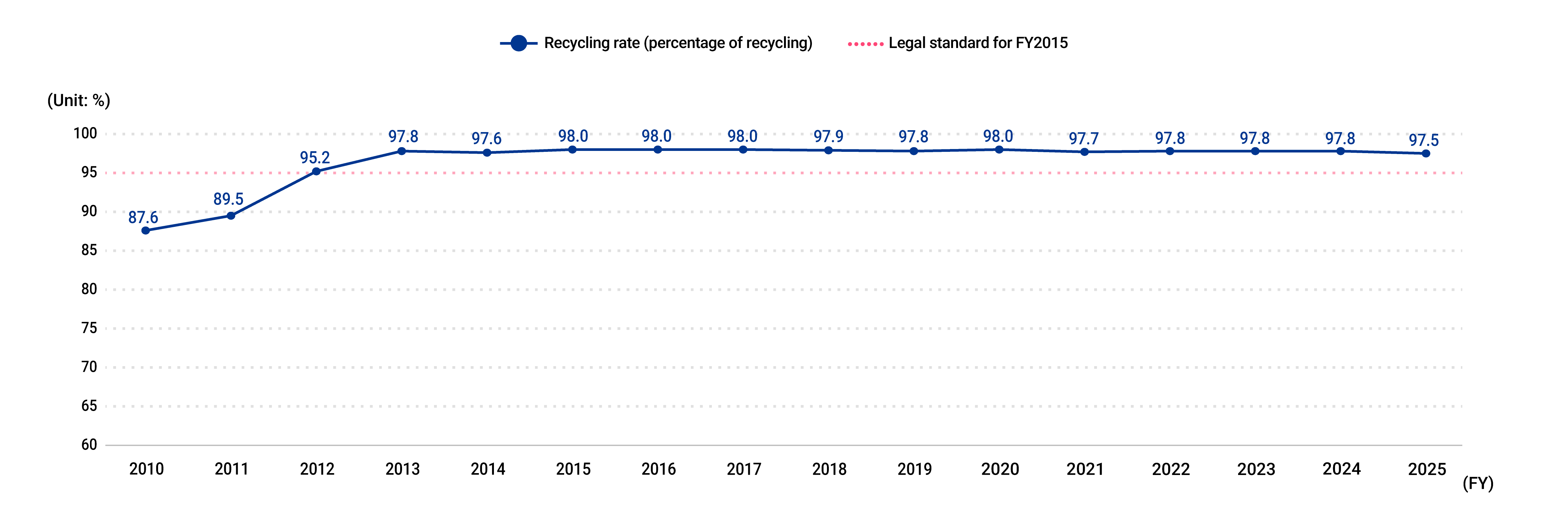
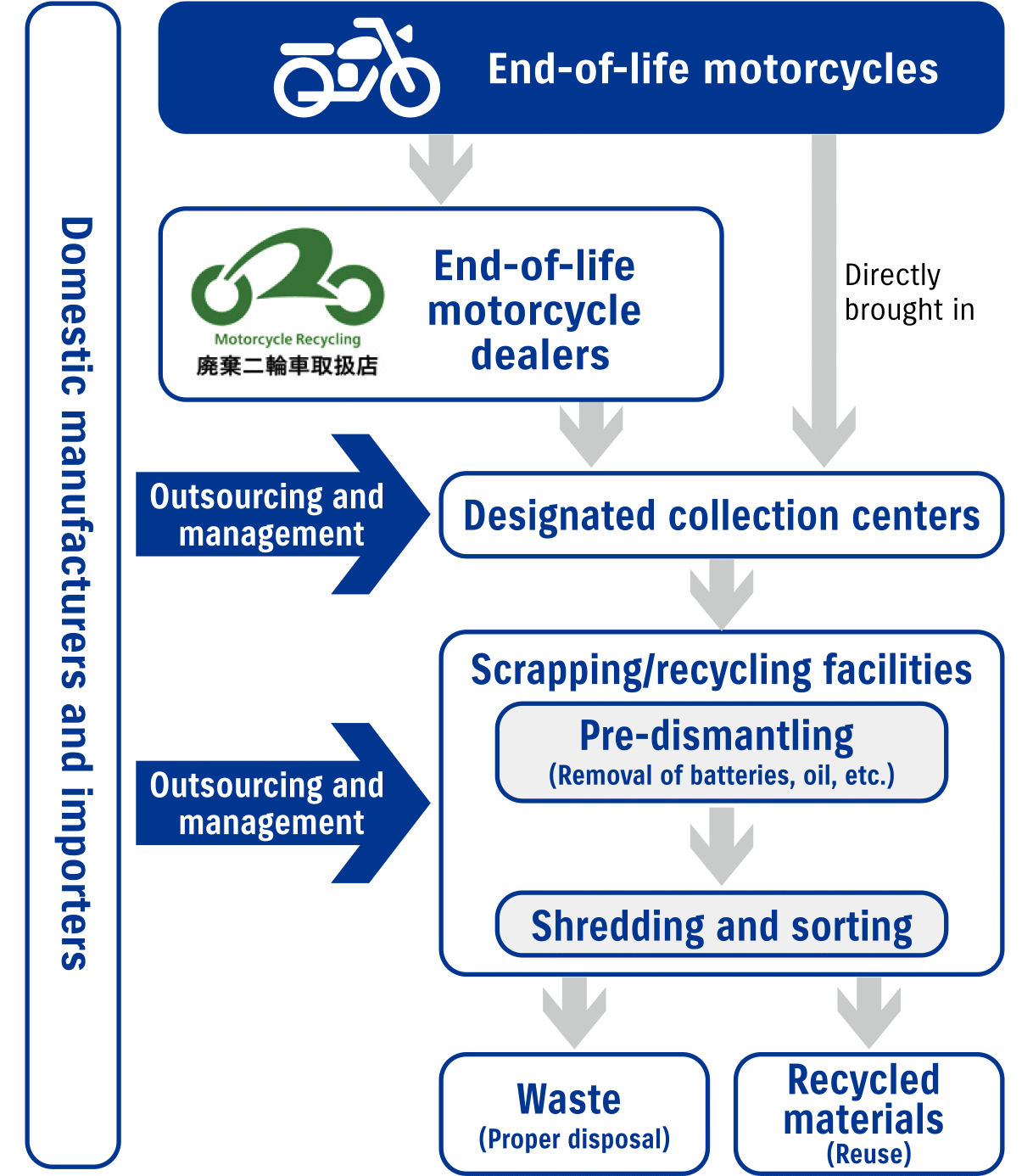
Our voluntary motorcycle recycling efforts were launched in October 2004, with the participation of four domestic motorcycle manufacturers and three importers (as of April 2025). These efforts have established a recycling system that is in line with the actual distribution of motorcycles in Japan and involves the disposal, scrapping, and recycling of used motorcycles. In October 2011, we began collecting motorcycles at the time of disposal free of charge. End-of-life motorcycles are taken back at end-of-life motorcycle dealers and designated collection centers throughout the nation for the convenience of our customers. These motorcycles are then collected at 13 scrapping/recycling facilities nationwide, where they are dismantled, shredded, and sorted. Materials that can be used as recycled materials are reused, while other waste materials are properly disposed of. Suzuki’s recycling rate in FY2025 was 97.5% on a weight basis, achieving the recycling rate target of 95%.
For details, please see the following websites.
Regarding Suzuki's voluntary motorcycle recycling efforts (detailed)
https://www1.suzuki.co.jp/motor/recycle/index.html
* The linked page is available in Japanese only.
Japan Automobile Recycling Promotion Center
(motorcycle recycling)
https://www.jarc.or.jp/en/motorcycle/
Trends in the recycling rate of Suzuki motorcycle products (from FY2010 to FY2025)
Voluntary efforts for recycling FRP* boats
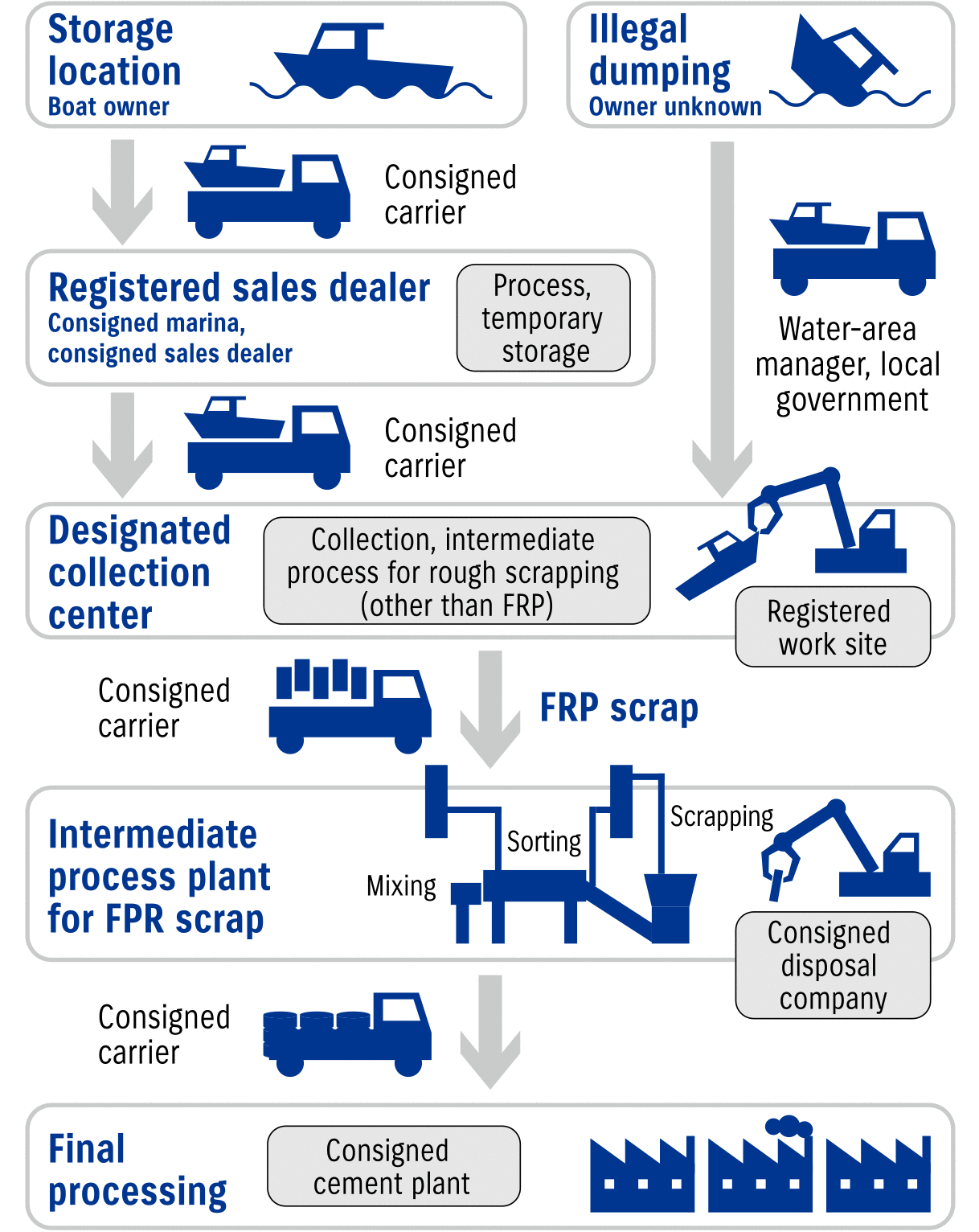
Suzuki actively participates in a program called the “FRP Boat Recycling System” voluntarily promoted by the Japan Marine Industry Association together with seven other major manufacturing companies.
The “FRP Boat Recycling System” has been developing nationwide since 2007 in order to prevent inappropriate scrapping of boats due to their product characteristics (such as large size, long life, and used nationwide yet small in volume) and to facilitate such scrapping for users. In the “FRP Boat Recycling System,” scrapped FRP boats collected at designated collection centers are roughly disassembled. Then, FRP scraps are transported to an intermediate processing plant, further scrapped, sorted, and finally baked to make cement, thereby carrying out recycling (material thermal recycling). This system is certified by verification tests conducted by the Ministry of Land, Infrastructure, Transport and Tourism, and realizes a recycling system at low cost by collecting, disassembling, and scrapping FRP boats over a wide area.
* FRP (Fiber-reinforced plastic)
For details, please see the following websites.
Suzuki Voluntary Efforts for the FRP Boat Recycling System
https://www1.suzuki.co.jp/marine/marinelife/recycle/index.html
* The linked page is available in Japanese only.
Japan Marine Industry Association FRP boat recycling business
https://www.marine-jbia.or.jp/recycle/index.html
Efforts in production
Efforts in production
Flow of waste, etc. (unit: thousand tons/year)
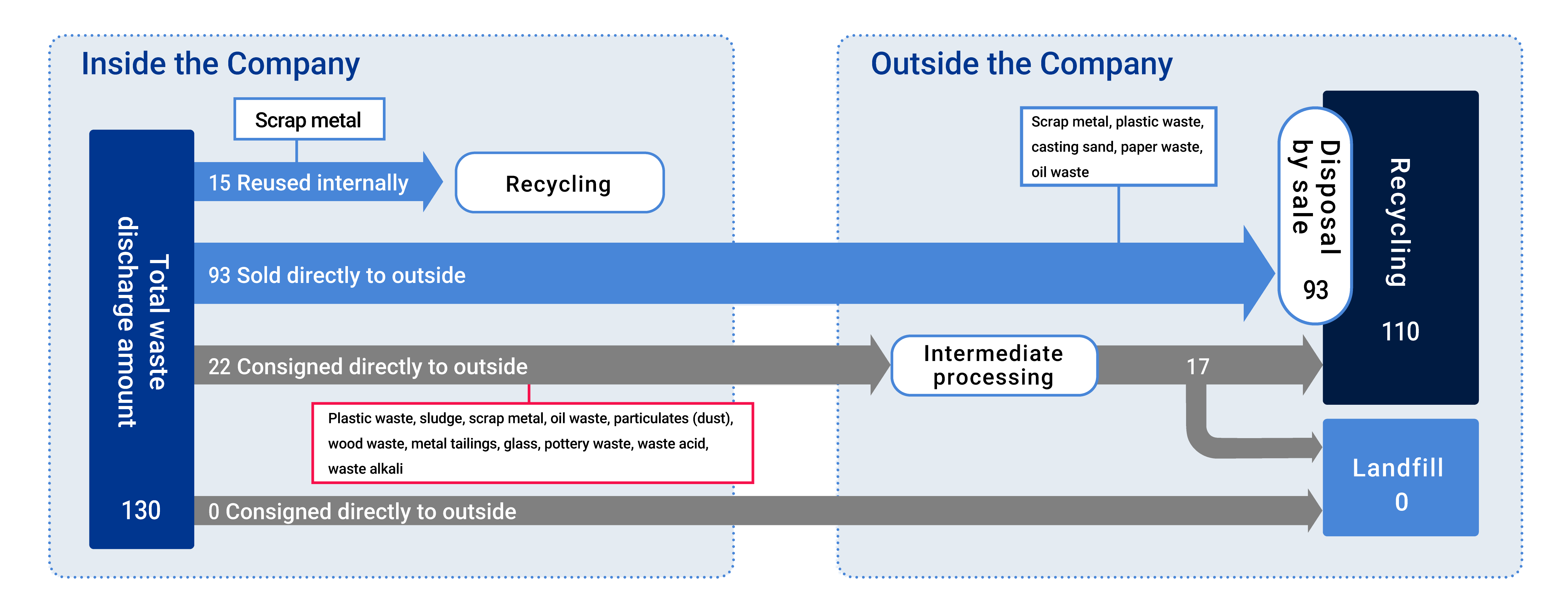
* Waste, etc.: A term referring to a combination of waste and valuable by-products.
[Scope of aggregation]
Head Office, Iwata Plant, Kosai Plant, Osuka Plant, Sagara Plant, Hamamatsu Plant, and the Tooling Dept.
Reduction of waste materials
Total waste disposal
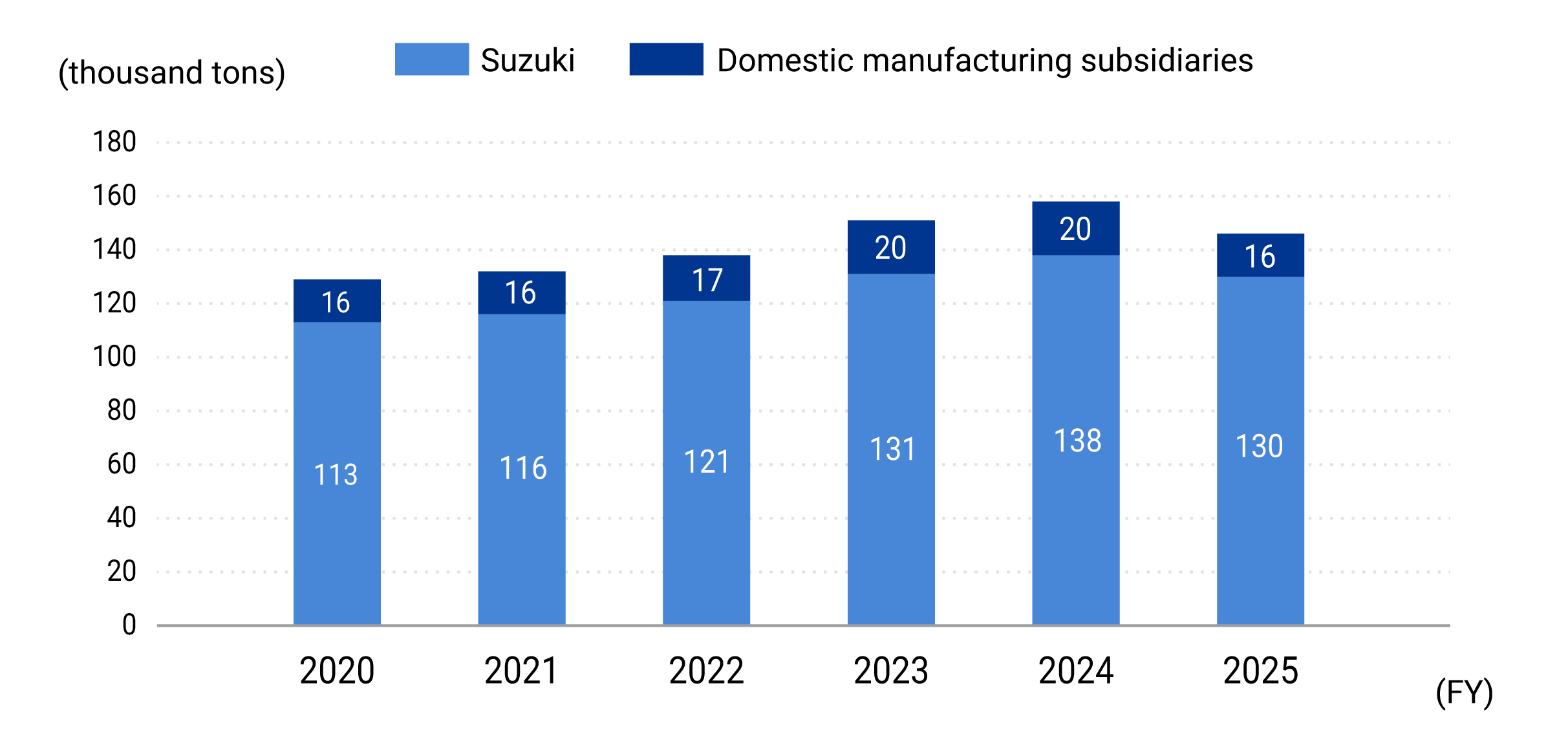
The total amount of waste discharged at Suzuki and domestic manufacturing subsidiaries was 146,000 tons (down 8% from the previous fiscal year).
Trends in total Suzuki Group waste discharge amount
[Scope of aggregation]
Suzuki (Head Office, Iwata Plant, Kosai Plant, Osuka Plant, Sagara Plant, Hamamatsu Plant, and the Tooling Dept.), 4 domestic manufacturing subsidiaries
Landfill waste amount
Suzuki and its domestic manufacturing subsidiaries achieved Zero level landfill waste volume* in FY2025 at 1.00 tons, and will continue to promote the maintenance of Zero level landfill waste volume.
* Definition of zero leveling
• Plants and Tooling Dept. in Japan: The total amount of landfill waste is less than 0.5% of the amount in FY1990 (24,675 tons).
• Domestic manufacturing subsidiaries: The total amount of landfill waste is less than 0.5% of the amount in FY2002 (1,370 tons).
Efforts in office activities, etc.
At Suzuki’s head office, generated paper waste was previously burned for thermal recycling (reused as heat energy). Since July 2005, however, we have engaged in material recycling instead of thermal recycling, through separate collection of office documents, newspapers and magazines, corrugated cardboard boxes, etc. We recycled 145 tons of paper waste in FY2025.
Response to the Plastic Resource Circulation Act
Suzuki has been recycling 100% of industrial waste from plastic products since 2001 and will continue 100% recycling in the future.
Going forward, in conjunction with efforts to reduce waste generation, we will promote material recycling through rigorous separation of waste, and aim for a recycling style where waste can be used again as raw materials for Suzuki products.
Efficient use of water resources
The Suzuki Group is working to reduce water intake and wastewater discharge through water-saving activities and water reuse, while also striving to make effective use of water resources by promoting water recycling.
Thorough water-saving and promotion of water recycling in production
The Suzuki Group is working to reduce the amount of water intake and wastewater through water-saving activities and water reuse, while also striving to make effective use of water resources by promoting the water recycle
<Efforts in production>
Thorough water-conservation and promotion of water recycling
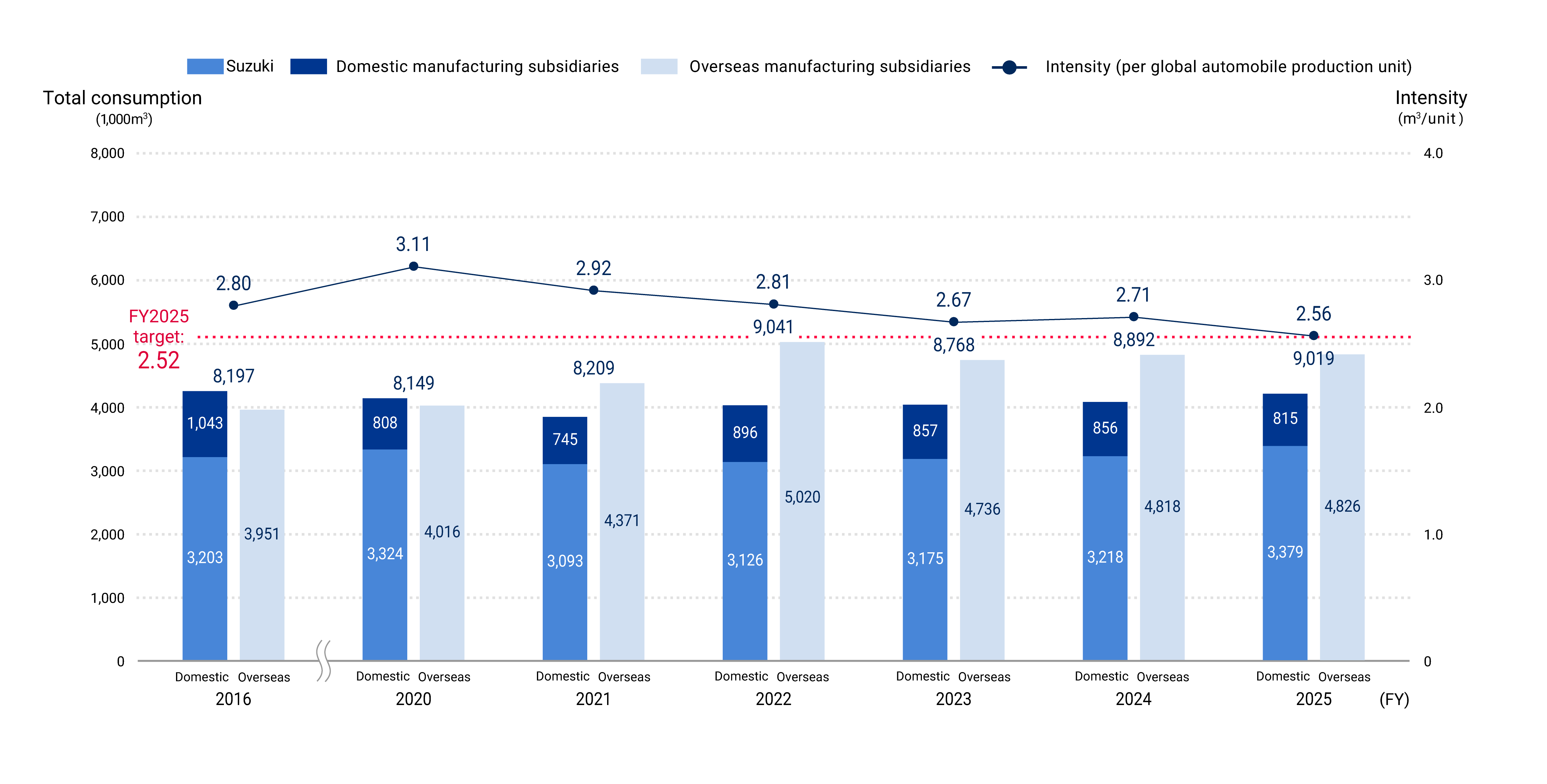
Under the Suzuki Environmental Plan 2025, Suzuki has been working to reduce water use by setting a target of a 10% reduction in water use intensity by FY2025 compared to FY2016, using the global automobile production volume as the denominator for water use intensity.
The Suzuki Group is promoting water-saving activities at plants both in Japan and overseas. When constructing new plants or renewing aging facilities, the Group is progressively adopting dry painting lines which can significantly reduce water use, as well as airtight cooling towers and air-cooled systems for compact air conditioners.
Additionally, in India where water-related risks are particularly high, we are promoting the reuse of wastewater in production processes by introducing wastewater recycling systems that use reverse osmosis (RO) membranes, in addition to implementing water-saving measures. Furthermore, by utilizing rainwater stored in on-site lagoons for use within the plant and for watering green spaces on the premises, we are promoting the recycled use of water, which leads to reductions in both water intake and wastewater discharge.
The amount of water used in FY2025 totaled 4.19 million m³ in Japan (a 2.9% increase from the previous fiscal year) and 4.83 million m³ at overseas manufacturing subsidiaries (almost flat compared to the previous fiscal year). The water use intensity per automobile production volume was 2.56 m³ per vehicle, a 5.5% improvement from the previous fiscal year’s 2.71 m³/unit, however, we did not achieve the target of 2.52 m³/unit. We will continue to promote water conservation and water reuse, and remain committed to the effective use of water resources and the reduction of water use.
Trends in global water use
Wastewater from production and daily life generated at our factories is purified at our own wastewater treatment facilities before being released into rivers or public sewerage systems.
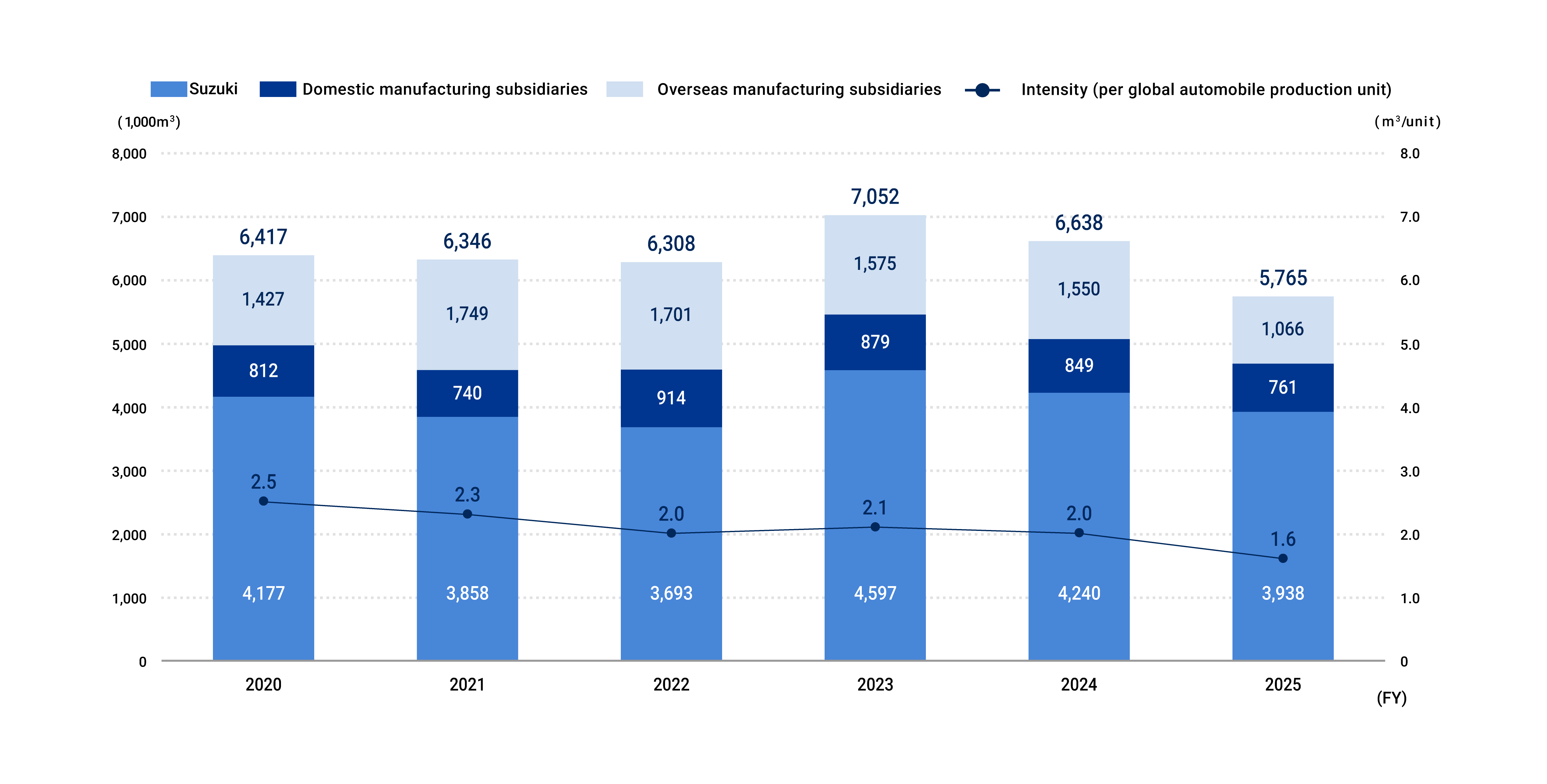
Water recycling has also reduced the amount of wastewater discharged, and global wastewater volume for FY2025 was 5.76 million m³, resulting in a wastewater discharge intensity per automobile production volume of 1.6 m³/unit.
Trends in global wastewater volume
[Scope of aggregation]
Suzuki (Iwata Plant, Kosai Plant, Osuka Plant, Sagara Plant, Hamamatsu Plant, and the Tooling Dept.), 4 domestic manufacturing subsidiaries, and 14 overseas manufacturing subsidiaries
Thorough water-conservation at offices and employee dormitories
In order to proactively reduce water use, we are making efforts in raising awareness about water conservation such as by announcing specific measures and posting water-saving awareness posters in restrooms and kitchens. We are also making efforts to reduce water use, such as by installing automated faucets for hand washing and introducing water-saving equipment.
Efforts in the Supply Chain, etc.
Efforts in procurement
Understanding information on the water risks of our business partners (Japan)
Suzuki annually surveys major domestic business partners that account for a large share of its procurement expenditure to obtain information on water-related risks. Through this research, we keep track of their water use trends and the status of water risk assessment. In the FY2025 survey, those evaluating their own physical risks such as flooding and droughts accounted for 85.3%, and those evaluating their own regulation and reputation risks regarding water usage accounted for 79.8%. We will continue to implement this initiative and gradually expand it to our overseas business partners as well.
Efforts in transportation
Reduction Initiatives
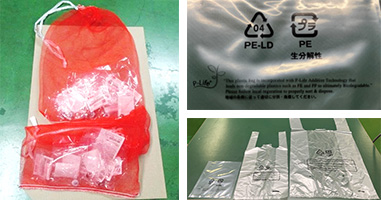
In order to reduce plastic waste generated from our business activities, in 2020 we started working on reducing plastic from packaging for outboard motor products and spare parts. We carried these activities in the following order or priority: (1) Can we discontinue plastic packaging? (2) Can we reduce plastic packaging? (3) Can we replace plastic packaging with more environmentally friendly materials? We are currently working to change product and spare part packaging materials from plastic to rayon, paper, and biodegradable materials.
From the beginning of the activities through March 2026, we reduced plastic by a total of approximately 187 tons.
Reduced shipping packaging materials
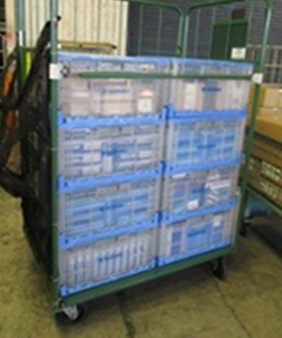
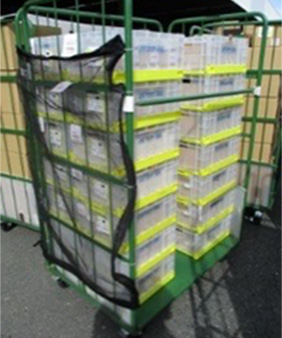
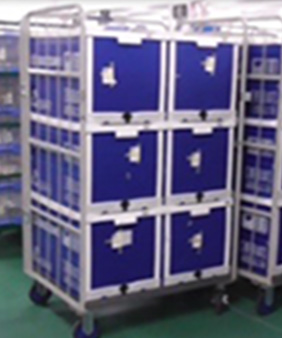
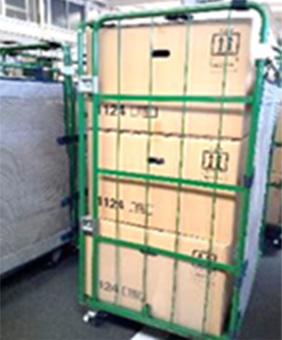
Use of returnable containers: Reuse of corrugated cardboard boxes
<Reduction in weight of packaging materials such as corrugated cardboard used for shipment of spare parts>
We are pursuing the use of returnable containers in our domestic shipping of spare parts. Moreover, we have implemented reuse (recycling) of used corrugated cardboard at our domestic parts centers.
In FY2025, we used returnable containers in approximately 35.3% of all shipping, which eliminated approximately 201.9 tons of cardboard boxes.
Reuse and recycling efforts
Reuse of waste materials
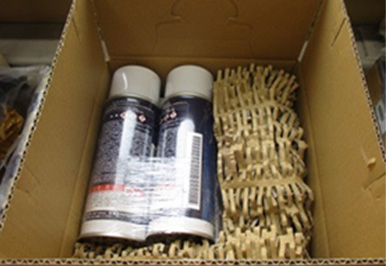
We reuse waste material produced in plants to make cushioning materials designed to prevent damage to spare parts during transportation. We reused approximately 0.5 tons of corrugated cardboard waste in FY2025.
Reduction of plastic packaging materials
We replaced the packaging plastic bags used for shipping spare parts to domestic parts centers with returnable bags, reducing plastic use. We are also working to protect the global environment by switching from petroleum-based plastic bags to biodegradable ones. In FY2025, we reduced our use of petroleum-derived polyethylene bags by approximately 9.8 metric tons.