GLOBAL SUZUKI

Feature:Suzuki as an “Indispensable Presence” Around the World

No. 1 in Automobile Market Share in 10 Countries Worldwide*

Suzuki has achieved the No. 1 automobile market share in 10 countries worldwide. By staying close to the daily lives of local communities and supporting people’s mobility and lives, Suzuki has become an indispensable presence.
* Source: Suzuki survey based on FY2025 sales results
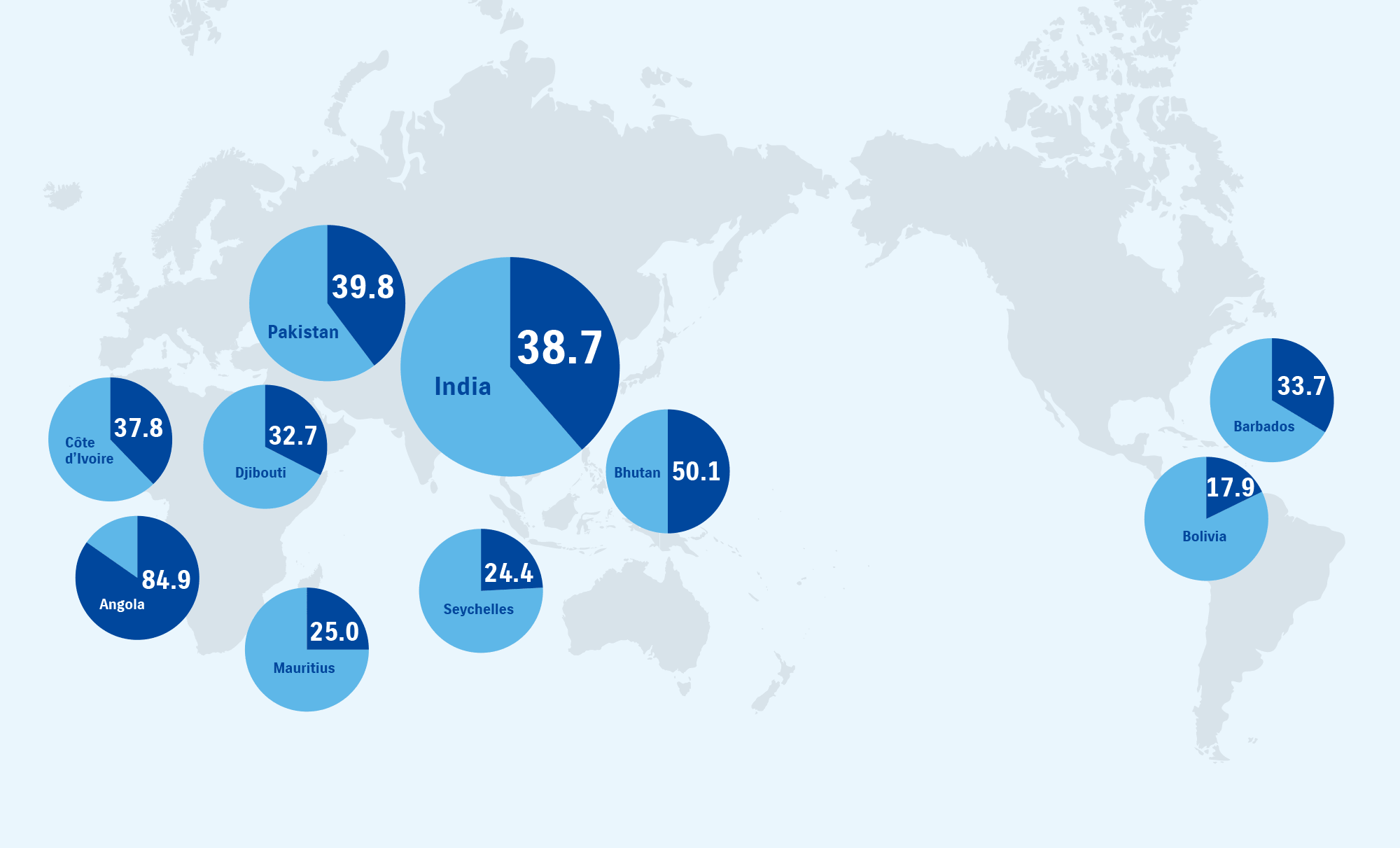
Automobile Market Share [India]38.7% [Bhutan]50.1% [Pakistan]39.8% [Seychelles]24.4% [Djibouti]32.7% [Somalia]25.0% [Mauritius]25.0% [Angola]84.9% [Côte d’Ivoire]37.8% [Barbados]33.7% [Bolivia]17.9%

Staying Close to Customers and Growing Together with Local Communities

Under its Mission Statement, which begins with “focusing on the customer,” Suzuki has engaged with the daily lives of customers and local communities, as well as with social issues. By thoroughly applying “Genba, Genbutsu, Genjitsu, Genri, Gensoku (Actual Place, Actual Thing, Actual Situation, Fundamental Principle, Fundamental Rule),” and pursuing the value that each individual customer truly needs, Suzuki has become a presence that supports people’s lives in many countries and regions.

Suzuki as an “Indispensable Presence” Around the World

Suzuki stays close to people around the world, supporting their mobility and daily lives.
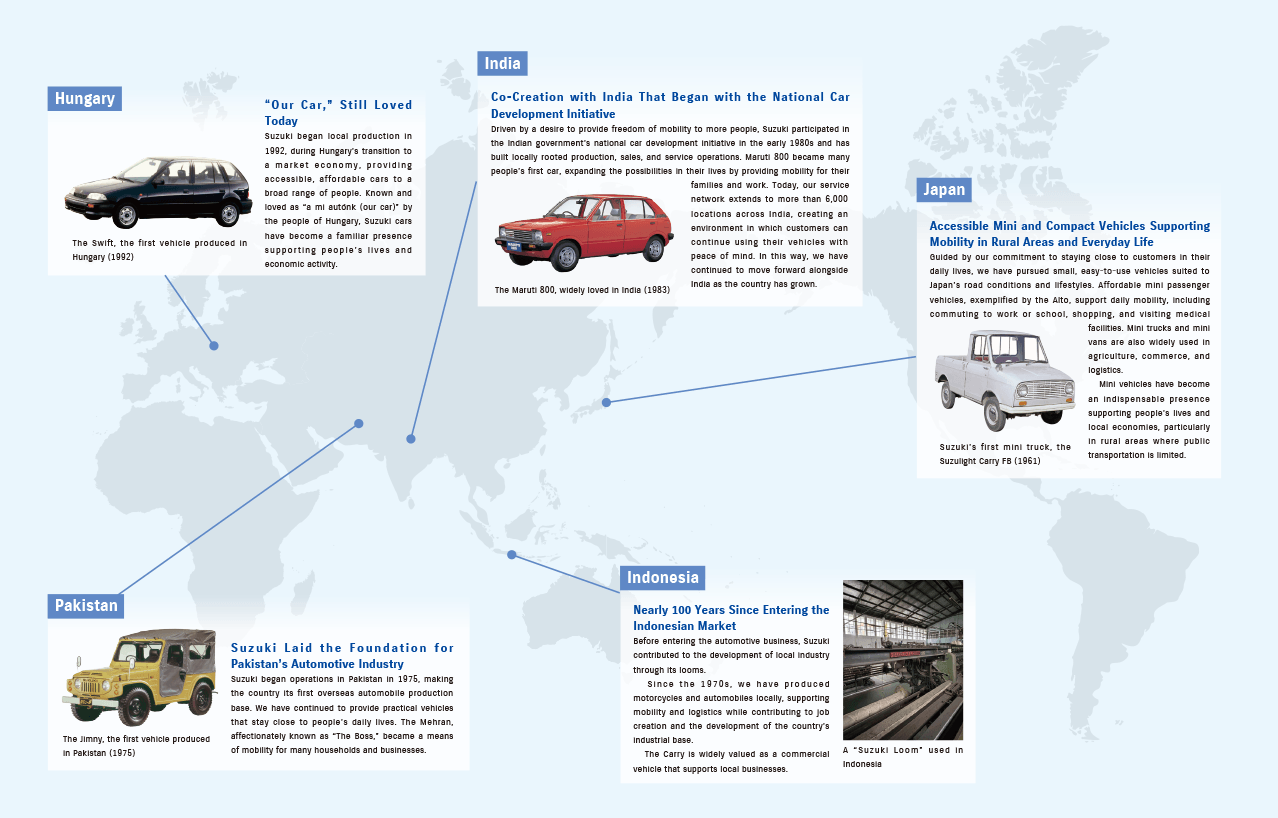
[Japan:Accessible Mini and Compact Vehicles Supporting Mobility in Rural Areas and Everyday Life]Guided by our commitment to staying close to customers in their daily lives, we have pursued small, easy-to-use vehicles suited to Japan’s road conditions and lifestyles. Affordable mini passenger vehicles, exemplified by the Alto, support daily mobility, including commuting to work or school, shopping, and visiting medical facilities. Mini trucks and mini vans are also widely used in agriculture, commerce, and logistics.Mini vehicles have become an indispensable presence supporting people’s lives and local economies, particularly in rural areas where public transportation is limited.Suzuki’s first mini truck, the Suzulight Carry FB (1961)[India:Co-Creation with India That Began with the National Car Development Initiative]Driven by a desire to provide freedom of mobility to more people, Suzuki participated in the Indian government’s national car development initiative in the early 1980s and has built locally rooted production, sales, and service operations. The Maruti 800 became many people[C1.1]’s first car, expanding the possibilities in their lives by providing mobility for their families and work. Today, our service network extends to more than 6,000 locations across India[C2.1][智小2.2], creating an environment in which customers can continue using their vehicles with peace of mind. In this way, we have continued to move forward alongside India as the country has grown.The Maruti 800, widely loved in India (1983)[Indonesia:Nearly 100 Years of Ties with Indonesia]Before entering the automotive business, Suzuki contributed to the development of local industry through its looms.Since the 1970s, we have produced motorcycles and automobiles locally, supporting mobility and logistics while contributing to job creation and the development of the country’s industrial base.The Carry is widely valued as a commercial vehicle that supports local businesses.A “Suzuki Loom” used in Indonesia[Pakistan:Suzuki Laid the Foundation for Pakistan’s Automotive Industry]Suzuki began operations in Pakistan in 1975, making the country its first overseas automobile production base. We have continued to provide practical vehicles that stay close to people’s daily lives. The Mehran, affectionately known as “The Boss,” became a means of mobility for many households and businesses.The Jimny, the first vehicle produced in Pakistan (1975)[Hungary:“Our Car,” Still Loved Today]Suzuki began local production in 1992, during Hungary’s transition to a market economy, providing accessible, affordable cars to a broad range of people. Known and loved as “a mi autónk (our car)” by the people of Hungary, Suzuki cars have become a familiar presence supporting people’s lives and economic activity.The Swift, the first vehicle produced in Hungary (1992)